

How to advertise on Victor Davis Hanson: In His Own Words: what it costs, who buys, and how to book

Dishant Miyani
Podcast Ad Analytics Head
Victor Davis Hanson sells his host-read inventory direct, quoted per campaign rather than off a public rate card, and almost all of it is coded direct response. Spotsnow data shows the overwhelming majority of ad reads on the feed carry a promo code or vanity URL, and the top host-read spender, Pure Health Research, has run roughly 36 to 42 reads on the show. That combination tells a buyer what this feed actually is: a performance channel with a historian's voice attached, not a brand-awareness placement. Spotsnow estimates all of this from tracked advertiser activity, not audience surveys.

Full profile data, roster, and spend estimates for Victor Davis Hanson: In His Own Words sit on Spotsnow.
Why Victor Davis Hanson: In His Own Words is built for host-read direct response
The host is Victor Davis Hanson, a classical and military historian with a PhD in classics from Stanford and a senior fellowship at the Hoover Institution. The show sits in the government category on Spotsnow, with history, news, and society and culture underneath it.
Spotsnow attributes nearly all of the show's tracked ad reads to direct response, which is unusually lopsided for a political commentary feed of this size. That matters because direct response needs two things to work: a code or URL the listener can act on, and enough attention left in the room for them to remember it. This show delivers the second one almost structurally. Episodes are long, unhurried, and built around a single argumentative throughline, so listeners aren't skimming for a punchline. When Hanson stops the analysis to read a sponsor, the tonal shift is small, because he's already in explanatory mode. That's exactly the state a host-read borrows from.
Spotsnow estimates the audience at roughly 99,000 listeners, an estimate rather than an audited count. The composition is the part buyers should underline: it skews male, older, high-income, and heavily concentrated in the United States. Not a broad feed. A specific one.
On engagement, the show carries a 4.8 average Apple Podcasts rating on roughly 1,300 to 1,450 ratings, and Hanson's YouTube channel sits at roughly 426,000 subscribers. His influence runs through the feed and the video channel rather than spreading thin across every social platform, which is why the roster is built on reads and not on social amplification bundles.
Who is advertising on Victor Davis Hanson: In His Own Words
Spotsnow tracked roughly 125 to 145 brands across the recent window, split between national produced spots dropped in programmatically and a smaller, stickier set of host-read performance advertisers. Recognizable names in the mix include Mint Mobile, USAA, Shopify, Carvana, and SimpliSafe.
The anchor advertisers, broken down
My Patriot Supply
My Patriot Supply sells emergency food storage and preparedness kits, and it runs on this show through a dedicated vanity domain. Spotsnow data shows roughly 19 to 22 host reads and estimated total spend of over $100K, classified entirely as direct response. The fit is about worldview more than product category: an audience that listens to a historian explain institutional fragility for an hour is already primed to buy against disruption.
Pure Health Research

Pure Health Research sells direct-to-consumer supplements, and it's the heaviest host-read buyer on the feed. Spotsnow attributes roughly 36 to 42 reads to the brand with estimated total spend over $100K, all direct response. Supplements convert on an older, higher-income audience that buys on recommendation rather than on packaging, and a trusted voice reading the offer does more work here than any amount of creative polish.
VAER Watches

VAER Watches builds US-assembled field and dive watches at a fraction of traditional luxury pricing. Spotsnow data shows roughly 11 to 13 reads and estimated total spend over $100K, again fully direct response. American sourcing and durability are the pitch, and that lands with listeners who have the disposable income for a considered purchase and a stated preference for things made at home.
The outlier: USAA
USAA runs steadily on the feed as a produced, awareness-style placement rather than a coded read. It's proof the show can serve a different objective. A national brand with a military and veteran membership base buys the association and the frequency, not the promo code, and it keeps coming back on that basis.
| Brand | Est. total spend | Direct-response | Time of spend (last 1 year) |
|---|---|---|---|
| My Patriot Supply | Over $100K | Yes | Spring 2026 to fall 2026 |
| Pure Health Research | Over $100K | Yes | Late 2025 through fall 2026 |
| VAER Watches | Over $100K | Yes | Summer to fall 2026 |
All spend figures are Spotsnow estimates.
Why government brands cluster here
The advertiser mix isn't random, and it isn't really about politics. Preparedness food, supplements, American-assembled watches, gold, home title protection: these are all categories sold on self-reliance and skepticism of institutions. Hanson spends every episode arguing that institutions are less durable than they look. By the time the read arrives, the listener has already accepted the premise the product depends on. That's a rare alignment, and it's why the same categories keep renewing instead of testing once and leaving.
The second half of the thesis is the demographic. Older, high-income, US-concentrated, and male-leaning is an expensive audience to reach anywhere else, and it's an audience that still acts on a spoken URL. Spotsnow data shows the roster splits cleanly: national brands take produced inventory for reach, while performance brands pay for Hanson's voice. If your category sells trust, authority, or durability, you're buying the second kind. If you're a DTC brand with a code and a landing page, this is a feed where the code actually gets typed.
How your ad could sound
Here's a confirmed host read from the show, a PragerU fundraising spot read in the middle of an episode. It's a cause read rather than one of the paid DTC anchors, but it's a clean sample of the mechanics on this feed.
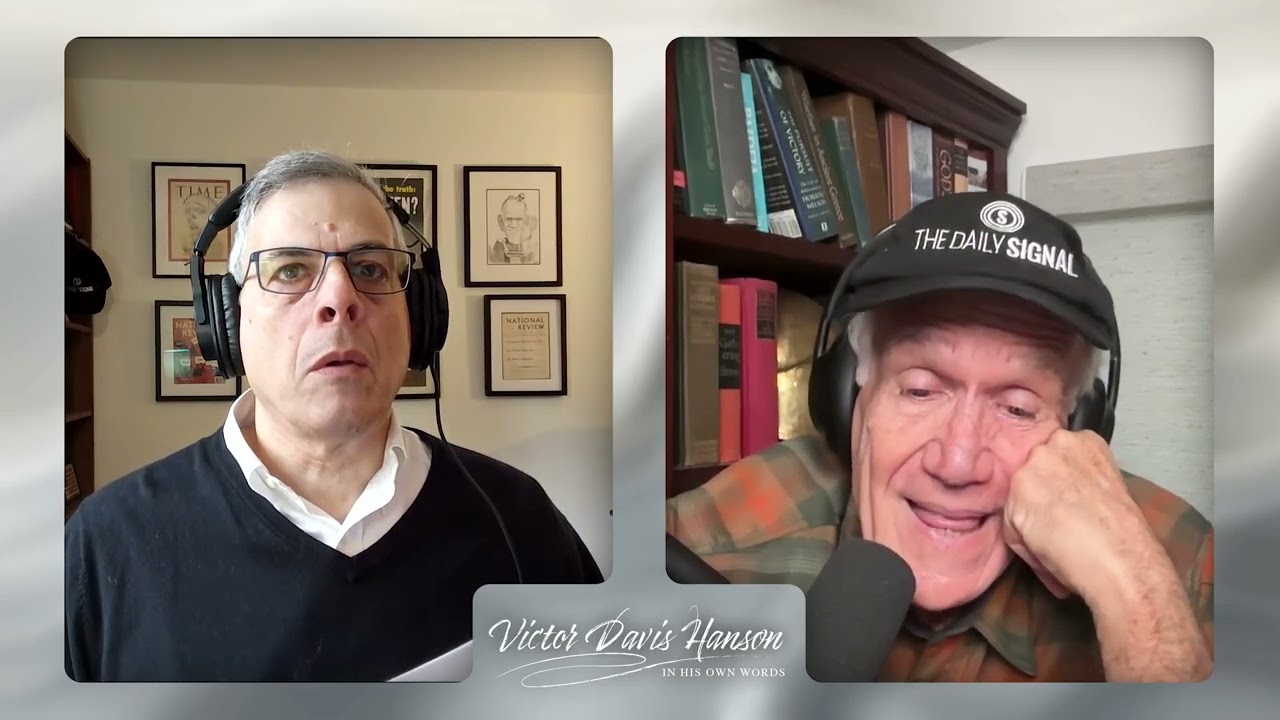
Host-read sponsor segment on Victor Davis Hanson: In His Own Words
What works in the read
The personal framing is strong. "Victor Davis Hanson is proud to be part of their family" does what a produced spot can't, which is transfer the host's standing to the sponsor. The handoff is natural, built out of an aside about a long friendship rather than a hard pivot. And the offer has a real deadline: the gift is "triple matched through December 31st," which gives the listener a reason to act today instead of later. Urgency plus endorsement is most of the host-read playbook.
What a buyer would fix
Two things. The hedge, "I don't want to call it an ad," humanizes the read but it also softens the ask right when the listener needs to be told what to do. And the URL gets spelled out awkwardly as "p r a geru dot com," which breaks recall on the one string the whole spot depends on. Pick a short, phonetic vanity URL, say it twice, and say it the same way both times. If you're writing a brief for this show, lean into the endorsement and the deadline, then protect the call to action from the host's own politeness.
View what a great sample ad looks like here.
What makes a show like this convert
- The format carries the offer. Spotsnow attributes nearly every tracked read on the feed to direct response, meaning advertisers are buying codes and URLs here, not impressions.
- Host credibility is the product. A Stanford-trained historian and Hoover Institution senior fellow reading your copy changes how a claim is received, which is why a 4.8 Apple rating matters more than raw download volume.
- The audience has money and attention. Spotsnow estimates roughly 99,000 listeners, skewing older, high-income, and US-based, which is a buying audience rather than a browsing one.
- Advertisers renew, which is the only real proof. Pure Health Research has run roughly 36 to 42 reads on this one show, and nobody buys that many times on a channel that doesn't pay back.
Victor Davis Hanson: In His Own Words in a nutshell
Forward this part to your team. The listener base is older, affluent, mostly male and overwhelmingly American, with Spotsnow estimating roughly 99,000 listeners and a 4.8 Apple rating. Preparedness, supplements, and American-made goods already buy here on repeat host reads, while national brands like USAA take produced inventory for reach. The show is sold direct and quoted per campaign, so there's no rate card to pull. If your KPI is coded conversions, this is a fit; if it's broad awareness, you'd be buying the smaller half of what the feed does well.
Frequently asked questions
Victor Davis Hanson: In His Own Words is sold on a quoted basis rather than a public rate card. Four things move the number: placement (mid-roll host-read prices above pre-roll and post-roll), read type (a host endorsement prices above a produced spot), commitment length (multi-episode flights and category exclusivity price better than a single test), and how close you are to the air date. For market context, a host-read spot on a typical show costs a brand roughly $20 to $30 for every thousand listeners it reaches. In-demand shows clear well above that. The more useful signal for this show is who already buys: Pure Health Research has run roughly 36 to 42 reads, alongside My Patriot Supply and VAER Watches. Repeat buying at that level tells you more about where a show prices, and what it's worth to the brands buying it, than an outside estimate can.
Ads run on most episodes, so the show is in demand and inventory moves fast. Plan on reaching out sooner than you think you need to.
Figure about 1 week to book, 2 to 3 weeks to produce and run, plus 2 to 3 weeks of lead time, so roughly 5 to 7 weeks end to end.
Victor Davis Hanson: In His Own Words is sold direct rather than through one of the large networks. You can approach the host's own operation, or book through a platform that already has the show in its inventory. You can view different advertising platforms here.
Depends on your category. Spotsnow tracked roughly 125 to 145 brands across the recent window, with host reads concentrated in preparedness, supplements, precious metals, home protection, and American-made consumer goods. Finance, telecom, retail, and insurance show up too, mostly as produced spots. If you sell a considered purchase to an older, higher-income US buyer, there's precedent on this feed; if you're targeting listeners under 30, there isn't much.
Victor Davis Hanson: In His Own Words isn't the only feed reaching this audience. Spotsnow shows which government podcasts have host-read spots open right now, and which brands already buy them.
Get on the last minute spots email list.
Find incredible discounts and opportunities on premium shows.
Get on the last minute spots email list.
Find incredible discounts and opportunities on premium shows.